
GAOQIAO Catalog Page
Mobile Traffic Light
Mobile Traffic Light is the inner part of our led traffic lights.
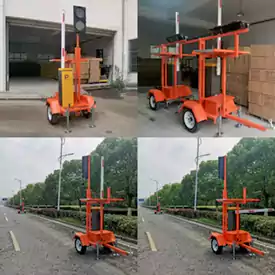
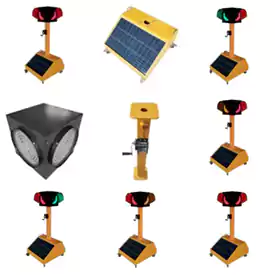
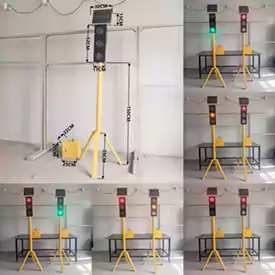
A mobile traffic light, also called a portable traffic signal or temporary traffic light, is a self-contained signal head mounted on a wheeled or trailer-based platform. It is deployed for temporary traffic control situations where permanent signals are inappropriate or unavailable: construction zones, road work, utility maintenance, emergency response, public events, and film shoots. The mobile design allows one technician to deploy a fully functional signalised intersection in 15-20 minutes, without trenching, cabling, or grid connection. GAOQIAO supplies mobile traffic lights in solar-battery hybrid and pure battery configurations, with optional wireless synchronization between paired units.
Technical Specifications
| Parameter | Standard Range |
|---|---|
| Lens diameter | 200 mm / 300 mm |
| LED colors | Red, Yellow, Green (3-aspect standard) |
| Solar panel | 50 W to 100 W mono-crystalline |
| Battery type | LiFePO4 or lead-acid deep-cycle |
| Battery capacity | 100 Ah to 200 Ah |
| Autonomy | 5-15 days without recharge |
| Mobility | Wheeled trolley, trailer, or pallet base |
| Wireless sync | 4G / LoRa / 2.4 GHz (optional) |
| IP rating | IP65 |
| Working temperature | -20 °C to +70 °C |
| Compliance | EN 12368 (where applicable), CE, RoHS, FCC |
How to Choose the Right Mobile Traffic Light
Five variables determine specification:
- Deployment duration: Short-term (1-7 days) typically uses pure battery. Long-term (weeks to months) requires solar hybrid to avoid manual recharging.
- Traffic volume: Higher volume roads need 300 mm heads for visibility. Low-volume rural or work-zone roads can use 200 mm.
- Synchronization requirement: Single-direction alternating (e.g., single-lane road works) needs two paired units with wireless sync. Complex multi-phase control needs a controller-equipped version.
- Vehicle maneuverability: Wheeled trolley is for pedestrian-deployment. Trailer with tow hitch is for frequent relocation between sites. Pallet base is for crane deployment.
- Local regulations: Some jurisdictions require pre-approval for temporary signals. Specifiers should verify with the local road authority before deployment.
A common mistake is specifying a mobile traffic light for permanent intersection use. Mobile units are designed for short-term deployment; long-term permanent use is the role of fixed 3-aspect LED traffic light or 4-aspect LED traffic light.
Key Features and Benefits
Wireless Pairing for Two-Way Control
Two mobile units can be wirelessly synchronized to provide alternating one-way traffic control on a single-lane road works. The pairing range is 500 m to 2 km line-of-sight, depending on the wireless technology selected. No cables between units means deployment in 15-20 minutes per site.
Solar Hybrid for Long-Term Deployment
The 50-100 W solar panel keeps the battery topped up in normal conditions, providing 5-15 days of autonomous operation even in extended overcast conditions. For 24/7 operation, the unit can be supplemented with a small generator.
Easy Relocation
The wheeled trolley or trailer configuration means one technician can relocate the unit daily if needed. This is valuable for road work that progresses along a road alignment.
Common Applications
- Single-lane road works (alternating one-way with paired units)
- Construction zone intersections (replacing permanent signals during work)
- Utility maintenance (water, gas, telecom)
- Emergency road closures (accident response, weather events)
- Public events (parades, marathons, festivals)
- Film and TV production (temporary road closures)
- Bridge repairs (replacing fixed signals during work)
- Mine and quarry vehicle control (mobile crossings)
For grid-connected temporary signalisation, see Traffic Light Controller. For portable flashing hazard markers, see Solar Warning Light.
Installation and Maintenance
Deployment: position the unit at the desired location, deploy stabiliser legs or wheel chocks, switch on, configure the timing plan via the front-panel keypad or mobile app. Wireless pairing is automatic within range. Deployment time: 15-20 minutes per unit.
Maintenance: visual inspection every 1-3 months depending on use intensity, battery health check every 6 months, solar panel cleaning as needed. The trailer/trolley mechanical components require standard equipment maintenance (wheel bearings, hitch, etc.).
Certifications and Compliance
Standard documentation: CE/RoHS/FCC, ISO 9001, 1-year warranty on the complete unit. Wireless synchronization certifications (FCC for US, CE-RED for Europe) on project basis. EN 12368 compliance for the signal head itself, but the mobile platform is generally certified as a complete system rather than against road-signal standards.
Why Choose GAOQIAO
GAOQIAO has manufactured mobile traffic lights in Nanjing since 2012, with deployments across 60+ countries including major road-work projects in the Middle East, North Africa, and Southeast Asia. Our 12,000 m² Nanjing facility produces 15,000 mobile and fixed signal heads per month at peak. OEM/ODM configurations supported. See cooperation cases and company profile.
Customer Inquiry
Leave A Message
Send your inquiry and leave your email. Our sales team will reply with product details, quotation and delivery information.